

If you stamp the same thing many times a day, choose a self-inking stamp. If you need large artwork, several ink colours from one design, or a stamp that keeps going for years with simple care, a traditional rubber stamp is usually the better choice.
That’s the short answer. The right pick depends on how often you stamp, what surface you stamp on and how big your design is. Dial A Stamp has made both types in Australia since 1982. This guide explains how each one works, where each one wins and which suits your industry, so you can order the right stamp the first time.
Traditional vs Self-Inking Stamps at a Glance
Self-inking stamps win on speed, cleanliness and consistency. Traditional stamps win on flexibility, design size and longevity. Here’s how they compare.
| Feature | Traditional rubber stamp | Self-inking stamp |
|---|---|---|
| How it inks | Pressed onto a separate ink pad before each impression | Built-in pad re-inks the die automatically every press |
| Speed | Slower, two steps per impression | Fast, one press per impression |
| Impression consistency | Depends on how evenly you ink and press | Very consistent, the mechanism controls ink and pressure |
| Mess | Separate pad, more chance of inky fingers | Clean, ink stays inside the casing |
| Ink colour flexibility | Any colour, just swap the pad | One colour per pad, change by swapping pads |
| Maximum design size | Suits large designs and artwork | Limited to the available frame sizes |
| Lifespan | Very long, no moving parts | Long, but the pad and spring wear over time |
| Upfront cost | Varies with size, ink pad bought separately | Varies with size, pad and mechanism included |
| Ongoing cost | Ink pads and refill ink | Refill ink and replacement pads |
| Best for | Large logos, multiple colours, packaging, crafts | High-volume admin, date stamps, everyday business details |
What Is a Traditional Rubber Stamp?
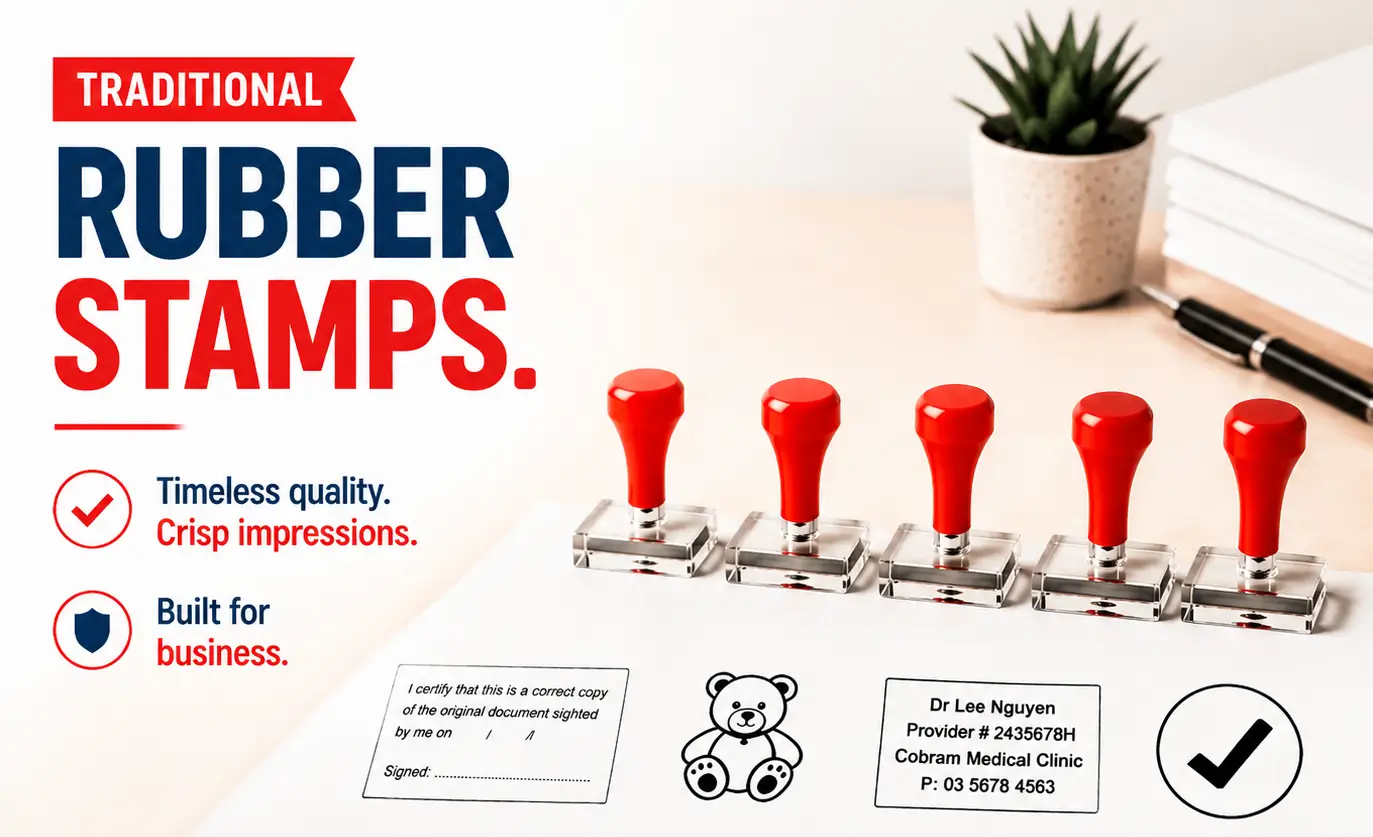
A traditional rubber stamp is the classic design: a rubber die fixed to a mount, which you press onto a separate ink pad and then onto your surface. There are no springs or moving parts, so there’s very little that can go wrong.
How a traditional stamp works
Your design is made into a rubber die and fixed to a mount, usually with a cushion layer behind it to help the rubber press evenly. Using one is simple:
- Press the die gently onto the ink pad (for bigger stamps, tap the pad onto the die instead).
- Check the ink coverage looks even.
- Press the stamp straight down with firm, even pressure.
- Lift it cleanly, without rocking.
Because you ink it by hand, each impression depends a little on technique. After a few goes, it becomes second nature.
Wooden handles and mounts
Traditional wooden rubber stamps use a timber mount and handle. They feel solid in the hand and, with no internal parts to wear out, can keep working for many years. Most have an index print of the design on top so you can line up each impression accurately.
Where traditional stamps shine
- Large designs: mounts aren’t restricted to set frame sizes, which suits big logos, labels and detailed artwork.
- Multiple ink colours: one stamp works with as many colours as you have pads. Red for an urgent notice today, blue for something else tomorrow.
- Specialty inks: you can pair the stamp with inks made for cardboard, fabric, glossy paper, plastic or metal. Just choose an ink rated for that surface.
- Awkward surfaces: you control the angle and pressure, which helps on boxes, bags and textured packaging.
What Is a Self-Inking Stamp?
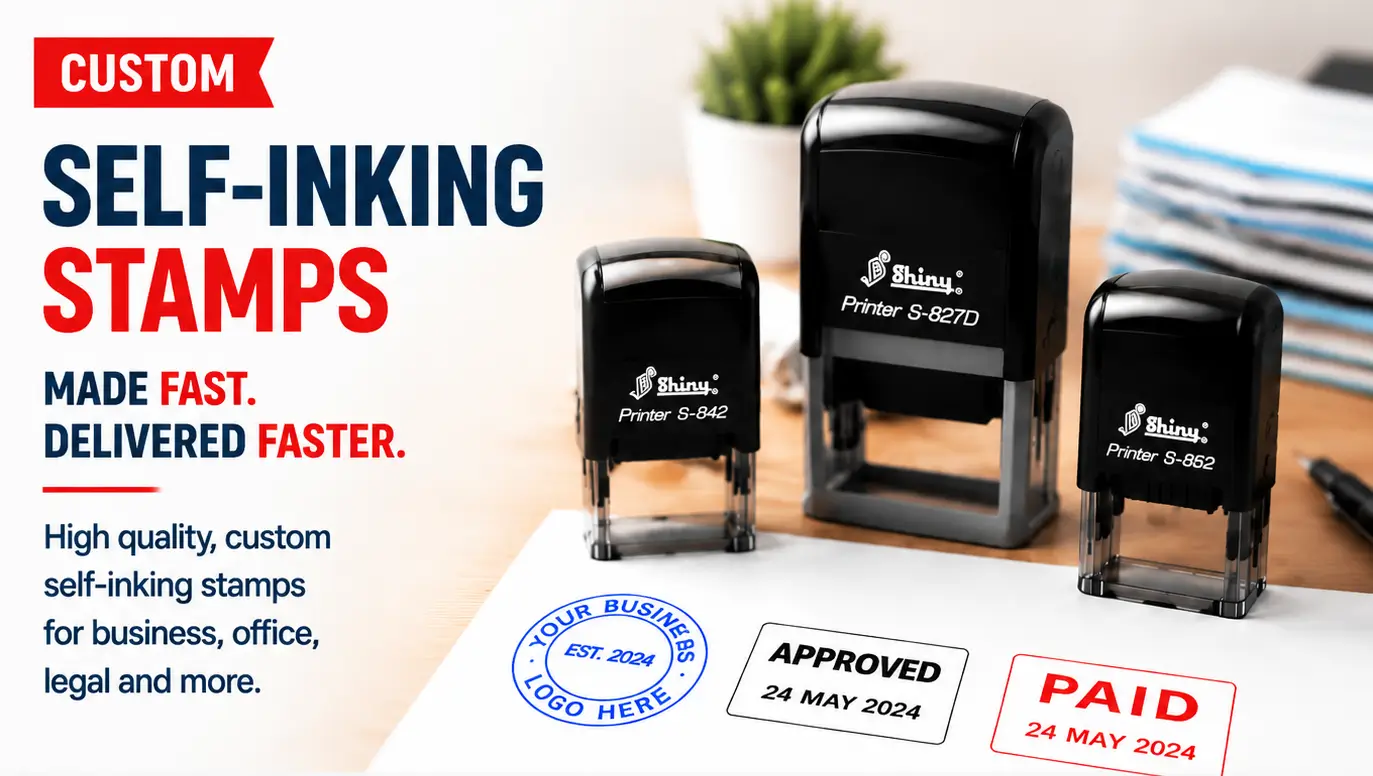
A self-inking stamp carries its own ink pad inside the casing. Each time you press down, the rubber die moves from the pad to the paper and back again, ready for the next impression straight away.
How the internal ink pad and flip mechanism work
At rest, the die sits face up against the ink pad inside the frame. Press the handle and a spring-loaded mechanism flips the die over so it faces the paper and makes the impression. Let go, and the spring returns the die to the pad, where it picks up fresh ink.
The result is one-handed stamping, no separate pad on your desk and similar ink coverage every time.
Re-inking and replacement ink pads
Yes, self-inking stamps can be re-inked. The pad dries out gradually with use, and you have two options:
- Re-ink the existing pad: slide the pad out of the frame, add a few drops of compatible ink spread evenly across the surface, let it soak in, then slide it back in.
- Replace the pad: if re-inking no longer gives a strong impression, the pad looks worn or damaged, or you want to change colour, fit a new one.
How often you’ll need to do this depends on how much you stamp, the ink and your working conditions. A stamp used all day at a front counter needs topping up far more often than one used once a week. Always use ink that matches your pad, and never mix ink types in the same pad.
Self-inking date and number stamps
Date and number stamps have adjustable rubber bands you roll with small thumbwheels to change the date, invoice number or batch number. Many combine fixed text, such as RECEIVED or PAID, with a changeable date underneath. They’re a favourite for mail rooms, accounts teams and dispatch areas. For practical ideas on putting them to work, read our guide on how to use self-inking stamps in your business.
Where Do Pre-Inked Stamps Fit In?
Pre-inked stamps are a third option, and they’re not the same as self-inking stamps. Instead of a separate pad that flips, the ink is held within the stamp material itself and released through the die when you press down.
- They give very crisp, detailed impressions, which suits fine logos and small text.
- There’s no flipping mechanism, so they’re quiet and smooth to use.
- You re-ink them by adding ink directly to the stamp.
If you see pre-inked while shopping, think of it as a premium choice for detail rather than a different name for self-inking.
Key Differences Between Traditional and Self-Inking Stamps
The biggest differences come down to speed, flexibility and design size. Here’s the detail on each.
Speed and stamping volume
Self-inking stamps are faster. Each impression is a single press, compared with ink then stamp for a traditional stamp.
- Working through a big pile of documents? Self-inking.
- Stamping now and then, or one-off jobs? Either works, and traditional gives you more options.
Impression quality and consistency
Self-inking stamps give the most consistent results day to day, because the mechanism applies similar ink and pressure each time. That’s useful when several staff share one stamp.
Traditional stamps can produce excellent, sharp impressions in practised hands, and they handle large solid areas well. If fine detail is the priority, pre-inked stamps are hard to beat.
Ink colours and ink types
- Traditional: use any colour or ink type you like, just change the pad.
- Self-inking: one colour per pad. Changing colour means swapping the pad, and you’ll need ink that suits that pad.
If you need specialty inks for non-paper surfaces, traditional stamps usually give you more freedom.
Design size and detail
Self-inking stamps are limited to the frame sizes available, which range from small stamps for a name and phone number up to larger office stamps. For big logos, larger artwork or bold packaging designs, a traditional mount offers more room.
Common seals and certification stamps can be made either way, depending on the size and detail of your design. Fine lines and very small text need careful artwork, so it’s worth reading our tips on creating unique designs for custom rubber stamps before you send through a logo.
Durability and lifespan
Traditional stamps generally last longer because there’s nothing mechanical to wear out. Look after the rubber and the stamp can keep working for a very long time.
A quality self-inking stamp also lasts years with reasonable care. Over its life, you’ll replace the ink pad, and eventually the spring and frame show wear in very heavy use.
Cost: upfront vs ongoing
We don’t quote fixed prices here, because the cost of a custom stamp depends on several things:
- the size of the stamp
- the complexity of your design or logo
- mount or frame type
- whether you need date or number bands
- how many ink colours or spare pads you want
For traditional stamps, remember to budget for an ink pad and refill ink. For self-inking stamps, the pad comes built in, and over time you’ll buy refill ink and replacement pads. In a busy office, the time saved with a self-inking stamp often matters more than small differences in running costs. For an exact figure on your design, request a quote.
Mess, portability and ease of use
Self-inking stamps are cleaner and more portable. The ink stays in the casing, so you can drop one in a bag or drawer. Traditional stamps need a pad nearby, and the pad lid should stay closed between uses to stop it drying out.
Which Stamp Is Best for Your Use?
Match the stamp to how often you’ll use it and what you’re stamping. Here’s our recommendation by industry.
Busy offices and administration
Best choice: self-inking. Everyday status stamps such as RECEIVED, PAID, APPROVED and ENTERED get used constantly, so speed and consistency win. A self-inking date stamp is the workhorse of most front desks and accounts teams.
Legal, corporate and certification work
Best choice: depends on the design. Self-inking stamps are popular for JP and certification work because they’re clean, portable and consistent. Larger common seal designs may suit a traditional mount.
Requirements for seals and certification stamps vary. Confirm any wording or formatting requirements with your company constitution or the relevant state or territory authority before you order, then send us the details for a proof.
Medical and healthcare practices
Best choice: self-inking. Practices often need provider details, practice names and addresses on a steady stream of referrals, forms and scripts. A self-inking stamp keeps that quick and tidy. If your stamp includes a detailed logo or small text, consider pre-inked for extra crispness.
Hospitality and retail
Best choice: both, for different jobs.
- Loyalty cards: a small self-inking or pre-inked stamp gives quick, clean impressions at the counter.
- Branded bags, boxes and packaging: a traditional wooden stamp with your custom logo allows a larger design and pairs with inks suited to kraft paper and cardboard.
Crafts, events and personal projects
Best choice: traditional wooden stamps. For invitations, gift wrapping, place cards and stationery, being able to change colours freely is a big plus. A wooden stamp also looks and feels the part.
Caring for Your Stamp So It Lasts
A little care goes a long way with either type. Here’s what we recommend after decades of making stamps.
Cleaning and storing traditional rubber stamps
- Wipe the die after use with a damp cloth or a stamp cleaner suited to your ink.
- Don’t soak the wooden mount in water.
- Store stamps flat, away from direct sunlight and heat, which can harden and crack the rubber.
- Keep ink pad lids closed so the pads don’t dry out.
Re-inking and maintaining self-inking stamps
- Re-ink at the first sign of fading, rather than waiting until the pad is dry.
- Use only ink that matches your pad.
- Don’t over-ink. A few drops spread evenly is better than flooding the pad.
- Gently wipe the die now and then to remove paper fibres and dust.
- If your stamp has a lock or cover, use it when the stamp isn’t in use.
Signs it’s time to replace a stamp or ink pad
- Impressions stay patchy or faint even after re-inking.
- The pad is hard, cracked or gives blotchy prints.
- The rubber die is cracked, hardened or worn at the edges.
- The self-inking mechanism sticks or doesn’t spring back.
- Your business details have changed, such as a new address or phone number.
Ordering a Custom Stamp from Dial A Stamp
Whichever type you choose, we can customise it with your business details, wording or logo. Dial A Stamp is a family-owned business that has been making stamps since 1982, and every stamp is Australian manufactured.
- Free proof and quotation Australia wide, so you can check your design before we make it.
- Same day dispatch when you order before 12pm.
- The full range: customised self-inking stamps, pre-inked stamps, traditional wooden rubber stamps, date and number stamps, common seal stamps, JP and certification stamps, and custom logo stamps.
Not sure which type suits you? Send us your design and how you’ll use it, and we’ll recommend the right option. Request your free proof and quotation today, and order before 12pm for same day dispatch.
Frequently Asked Questions
Are self-inking stamps better?
They’re better for speed, cleanliness and consistent impressions in high-volume work. Traditional stamps are better for large designs, multiple ink colours and specialty surfaces.
What are the differences between a self-inking stamp and a traditional rubber stamp?
A self-inking stamp has a built-in pad that re-inks the die with every press, while a traditional stamp is pressed onto a separate ink pad by hand. That makes self-inking faster and tidier, and traditional more flexible.
What is the difference between self-inking stamps and pre-inked stamps?
Self-inking stamps use a separate internal pad and a flipping mechanism, while pre-inked stamps hold the ink inside the stamp material itself. Pre-inked stamps typically give crisper, more detailed impressions.
Does it matter what type of stamp you use?
Yes, because the right type saves time and gives better results for your task. Match the stamp to how often you stamp, your design size and the surface you’re stamping on.


